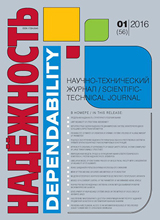
Peer-reviewed research and practice journal
The Dependability Journal has been published quarterly since 2001. The journal is on the list of top magazines and publications of the Higher Attestation Commission (HAC) of Russia. Since 2010, the Journal has been issued with the support of JSC RZD. Since 2012, it has been published in two languages, Russian and English.
The journal covers a comprehensive list of topics, including structural and functional dependability management, functional safety and information security of systems, their standardisation and certification, management of risks of system safety and dependability disturbance, management of technical assets of large systems, problems associated with ensuring the survivability and fault-tolerance of technical systems. The Journal frequently addresses research findings regarding artificial intelligence, machine learning and intelligent transportation systems.
The Dependability peer-reviewed research and practice journal is on the list of leading peer-reviewed scientific journals recommended by the Higher Attestation Commission of Russia for publishing key research findings of Candidate and Doctor of Engineering dissertations in the following fields of study:
1.2. Computer science | 1.2.1. Artificial intelligence and machine learning (physics and mathematics) 1.2.2. Mathematical simulation, numerical techniques and software systems (physics, mathematics and engineering) |
2.3. Information technology and telecommunications | 2.3.1. Systems analysis, information management and processing, statistics (engineering) |
2.3.3. Process and production automation and management (engineering) | |
2.3.4. Organisation management (engineering) | |
2.3.5. Computer system and network software (engineering) | |
2.3.6. Methods and systems of information protection, information security (engineering) | |
2.9. Transportation systems | 2.9.1. Transportation systems of the nation, its regions and cities, organisation of transportation (engineering) |
2.9.4. Transportation process management (engineering) 2.9.8. Intelligent transportation systems (engineering) |
The Dependability Journal is part of category K2 of the HAK list of peer-reviewed scientific publications (line 1483), approved by memorandum of the Higher Attestation Commission under the Ministry of Science and Higher Education of the Russian Federation dated December 6, 2022 no. 02-1198 On the categorisation of the List of peer-reviewed scientific publications.
Current issue
СИСТЕМНЫЙ АНАЛИЗ, УПРАВЛЕНИЕ И ОБРАБОТКА ИНФОРМАЦИИ, СТАТИСТИКА. СТРУКТУРНАЯ НАДЕЖНОСТЬ
Aim. The main focus is on developing a method for assessing and predicting the dependability of mining dump trucks using artificial neural networks. The key objectives are to solve the problem of telemetry data imbalance and identify complex time dependencies in sensor readings for accurate failure prediction.
Methods. The authors used standard data processing methods (linear interpolation, normalisation), fast Fourier transform for signal compression, and a hybrid neural network architecture combining LSTM and fully connected layers. The model was evaluated using the Precision, Recall, F1-score, and ROC-AUC metrics.
Results. The developed model demonstrated complete failure detection Recall = 1,0 with satisfactory separating ability AUC-ROC = 0,919. Applying a probabilistic approach to the target variable enabled a failure time window prediction accuracy of 97%.
Conclusion. The study confirmed the effectiveness of the proposed method for predictive maintenance of mining equipment. The proposed method can be recommended for industrial implementation. It may also extended to predict failures of other types of equipment.
Aim. The paper examines algorithmic methods for extracting stable formal features of discharge processes in ignition systems of internal combustion engines, aimed at their application in intelligent diagnostic systems.
Methods. The study is based on the mathematical analysis of time-domain, spectral, and spectro-cepstral characteristics of spark discharge signals generated in the secondary circuit of the ignition system. Cepstral methods are employed as the core analytical tool, providing robustness of the extracted features to noise, drift of measurement channels, and variations in engine operating modes. A multilevel model for generating diagnostic features is proposed, incorporating stages of signal preprocessing, normalisation and regularisation, time-frequency decomposition, and nonlinear parameterisation of the feature space.
Results. An algorithm for extracting invariant characteristics of discharge processes is developed, based on a combination of spectral analysis and statistical criteria of feature informativeness. As a result, a formalised feature vector suitable for the application of machine learning and intelligent data analysis methods is constructed.
Conclusion. An experimental study conducted on datasets of discharge signals from both healthy and faulty ignition systems confirms an increase in the accuracy and stability of diagnostic state classification. The findings can be used in the development of embedded and bench-based automated diagnostic systems for spark ignition processes.
A model for assessing the residual life of high voltage circuit breakers is proposed. The initial data used include data on the consumption of commutation life by short-circuit clearings, as well as data on changes in circuit breaker component wear due to mechanical, electrical, and thermal effects. Intelligent analysis of circuit breaker diagnostic results includes information on the circuit breaker’s technical condition; analysis of the circuit breaker component wear rate; the date and scope of circuit breaker monitoring; circuit breaker wear dynamics, etc. The analysis allowed developing information and methodological materials to support personnel for the purpose of improving the efficiency of facility planning and wear restoration timelines, reducing the risk of wrong decision.
Aim. To establish the relationship between the spectral characteristics of low-frequency electrical noise and the presence of defects in semiconductor materials. To establish the relationship between the spectral characteristics of low-frequency electrical noise and degradation processes in semiconductor devices. To identify the feasibility of using electrical noise for non-destructive testing of semiconductor devices and improving their dependability.
Methods. The article uses methods of the probability theory and random processes theory.
Results. An analysis of electrical noise in semiconductors caused by traps formed by structural defects and dominating in semiconductors in the low-frequency range has shown the following. A very general expression was calculated for spectrum noise in semiconductors caused by traps. It describes the spectrum of fluctuations caused by the process of capture and emission of carriers by traps in the presence of statistical relationships between successive events of the process, with statistical relationships specified in a general form. The resulting expression defines the relationship of the spectral characteristics of electrical noise with the number and characteristics of traps formed by defects and with the characteristics of the semiconductor. This expression is true for traps formed by different types of structural defects and can be applied to semiconductors of various types. As a result, a relationship was established between electrical noise and the presence of defects in semiconductors. As a result of the analysis of degradation processes in semiconductor devices and the study of the relationship of electrical noise with degradation processes, the following was obtained. A relationship was established between electrical noise and degradation processes in semiconductor devices. The relationship of electrical noise with both the degree of degradation and the degradation rate of semiconductor devices was strictly shown. It was found that the noise intensity characterises the quality of the manufactured device. It was shown that the noise level is associated with the aging rate of the electronic device. As a result, it was found that the electrical noise spectrum contains information on the quality deficiencies of a semiconductor device, both arising during the manufacturing process and manifesting themselves in operation. As a result of studying the feasibility of using electrical noise to improve the dependability of semiconductor devices, the following was obtained. The feasibility of effectively measuring electrical noise containing information on the degree of degradation and the degradation rate of semiconductor devices was shown. For the first time, the feasibility of identifying the degradation rate of semiconductor devices from measuring electrical noise was strictly substantiated. This enables a fundamental improvement in non-destructive testing of semiconductor devices, since the degradation rate is a key characteristic that defines the duration of failure-free operation of a device. As a result, the feasibility of using electrical noise to significantly increase the reliability of semiconductor devices has been demonstrated.
Conclusions. The results obtained in the article substantiate the use of electrical noise for non-destructive testing of semiconductor devices. Moreover, quality assessment is carried out not only on the basis of the current state of the device, as is it traditionally done, but also the rate of degradation changes in the device is assessed. The use of electrical noise for non-destructive testing of semiconductor devices, which allows identifying both the degree of degradation and the degradation rate of the device, makes it possible to fundamentally improve non-destructive testing of semiconductor devices, which contributes to improving their reliability.
СИСТЕМНЫЙ АНАЛИЗ, УПРАВЛЕНИЕ И ОБРАБОТКА ИНФОРМАЦИИ, СТАТИСТИКА. ФУНКЦИОНАЛЬНАЯ БЕЗОПАСНОСТЬ
Aim. This paper aims to build a methodology for identifying the probability of failure on demand of a monitoring and control system of a high operational risk facility. The method is based on Markov chains. The initial assumptions for the model are the possibility of explicit (detectable) and hidden (undetectable) failures in the control and safety system. As it is known [1], in case of a manifested system failure, remedial measures are taken. In the course of a recovery operation, the controlled facility is disabled, therefore, during this period no operation demand may occur. In the event of a hidden failure of a control system, the system may receive operation signal that will be missed. The constructed model may produce a non-stationary and stationary solution. In the non-stationary case, the obtained system of Kolmogorov differential equations is solved numerically, while in the stationary case, an analytical solution of the resulting system of algebraic equations is found. In addition, the paper examines the effect of the model parameters on the final estimated characteristics.
Methods. Markov models are used for describing the examined technical system. The final probabilities were obtained using a developed system of Kolmogorov equations. A stationary solution was obtained for the system of Kolmogorov equations. Classical methods of the probability theory and mathematical dependability theory were used. A numerical solution to the system of differential equations was found using a 4th order Runge-Kutta method.
Conclusions. The obtained stationary solutions conservatively estimate the probability of failure on demand and the probability of false operation.
ИНТЕЛЛЕКТУАЛЬНЫЕ ТРАНСПОРТНЫЕ СИСТЕМЫ
Aim. Developing a reproducible methodology for identifying source code «hotspots» based on Git data to better understand development history, identifying flawed areas and architectural deficiencies.
Methods. The study employs relational analysis to enable end-to-end analytics of development history by linking the entities File → Commit → Pull Request → Issue. Three key criteria are used: file change frequency, number of contributors, and the number of bugfix changes.
Results. The methodology was tested on real API service data from two intelligent transportation systems. Ranked lists for each criterion were obtained along with their association with the system’s functional components.
Conclusion. An analysis of a relational repository provides valuable insights into development history, helps identify code areas requiring greater attention, and thereby improves software quality.
АВТОМАТИЗАЦИЯ И УПРАВЛЕНИЕ ТЕХНОЛОГИЧЕСКИМИ ПРОЦЕССАМИ И ПРОИЗВОДСТВАМИ
This article presents a practical implementation of a software environment based on the latest versions of the MATLAB computer mathematics matrix system and the Simulink block-based simulation package. This environment serves as a tool for investigating the impact of asymmetry in the receiver path of Continuous Automatic Cab Signaling, specifically the deviation in the precision of electrical characteristics of onboard receiving coils, on the noise immunity of onboard equipment under affected by traction current harmonic interference. The developed simulation model enables rapid modification of key parameters and characteristics with real-time visualization of the results.
УПРАВЛЕНИЕ В ОРГАНИЗАЦИОННЫХ СИСТЕМАХ
Aim. To present a software suite for predicting rail freight rates that ensures stable and reproducible computational procedures based on ensemble methods of machine learning.
Methods. The study employs methods of mathematical analysis and machine learning, including ensemble stacking with a linear meta-model and definition of weight coefficients using the least squares method with Tikhonov regularisation. The architecture of the suite is defined by the principles of software system life cycle.
Results. A software suite has been developed that integrates processes of data loading and validation, feature generation, model training, and forecast aggregation. Computational experiments have confirmed that when the model is relaunched, the results are reproduced with high accuracy, and the metric values remain stable even under changing initial conditions.
Conclusion. The developed software suite provides a transparent computational logic and enables traceability of every analytical step from the input data to the final predictions. This structure improves confidence in the findings and makes the suite an effective tool for supporting decision-making in the area of freight rate planning.
ИСКУССТВЕННЫЙ ИНТЕЛЛЕКТ И МАШИННОЕ ОБУЧЕНИЕ
Aim. One of the major challenges of our time, when neural networks develop and evolve to suit the needs of semantic segmentation of aerial and satellite images, is choosing neural network models for solving various classes of tasks depending on the respective classes of objects on the Earth’s surface based not on a comparison demonstrating the applicability, but as a result of a quality evaluation of the neural network models as a whole and at all stages of deep learning process. The assessment itself thus is classified as multi-criteria (multi-component).
Methods. The article uses methods of multi-criteria (multi-component) assessment based on the convolution of target indicators.
Results. The article discusses target quality indicators that can be used to assess the quality of neural network models and suggests the respective aggregate indicators based on petal and radial diagrams, presents the result of such quality assessment using the example of data with objects on the surface of a water body isolated in satellite images using neural networks.
Conclusions. Aggregate indicators based on radial and petal diagrams can be used for a multi-criteria (multi-component) assessment of the quality of neural network models and enable decision-makers to select the best neural network model suitable for a specific decision-making situation.
ИСТОРИЯ И ПЕРСПЕКТИВЫ РАЗВИТИЯ ТЕОРИИ НАДЕЖНОСТИ И БЕЗОПАСНОСТИ ТЕХНИЧЕСКИХ СИСТЕМ. ВЗГЛЯД СКВОЗЬ ВЕКА

ISSN 2500-3909 (Online)